Aspirational fashion and food & beverage brands have driven activity, with falling voids, emerging rental growth and reduced incentives reinforcing confidence. Footfall has also improved, as consumers return to the high street for a better shopping experience, supported by click-and-collect and ongoing fulfilment challenges encouraging in-store visits.
However, recent global financial uncertainty has introduced a more cautious outlook. Rising wages, business rates and operational costs are creating a complex trading environment, and with a fragile consumer, the extent to which these costs can be passed on remains unclear.
This may lead to further consolidation across some larger retailers and banks, while pressures in the food & beverage sector, highlighted by early signals from operators such as BrewDog, are creating challenges for both independents and national brands.
Despite this, there are positives. The regions and towns we cover continue to see population growth, and the resilience shown by occupiers since COVID means many are well placed to navigate current headwinds. Stronger operators will continue to find opportunities to expand, although, as explored below, unlocking those opportunities remains a key challenge.
In Town
Cambridge
Cambridge city centre has demonstrated strong resilience, supported by robust occupier demand and continuous tourist and visitor footfall throughout the year.
Like Oxford, limited availability of retail stock has driven increased competition for vacant units within the historic core. Demand remains heavily led by food and beverage operators, particularly London-based brands seeking expansion into new regional markets. Cambridge is increasingly seen as a key target destination for these operators. There is still healthy demand from independent occupiers across both retail and food & beverage, providing the diversity of offer for the Cambridge visitor.
Recent notable lettings include Blank Street Coffee, Rudy's Pizza and Wingstop, alongside a new unit for Uniqlo within the Grand Arcade.
Take-up over the past six months has declined. This reduction is largely attributed to a tightening supply of available units and a lack of new development.
Development activity in and around the Grafton Centre is underway, with the demolition of Abbeygate House. The redevelopment will introduce significant new office and laboratory space, complemented by ground-floor retail.
Chelmsford
Chelmsford has been relatively quiet over recent months. However, the closure of the Regional Co-op department store leaves a significant void, combined with the uncertainty surrounding the redevelopment of The Meadows Shopping Centre.
High Chelmer has been strengthened by the arrival of H&M, while Bond Street, with the arrival of Goldsmiths, provides further quality to an already strong line-up.
Ipswich
Ipswich continues to face challenges; the Butter Market Shopping Centre sale may allow new investment to help mitigate the current voids.
The arrival of Jamaica Blue is a positive story, but vacant units, particularly larger stores, remain high.
Norwich
Norwich continues to attract new occupiers, with the availability of retail stock reducing by approximately 12,000 sq ft over the previous six months.
Recent take-up has been dominated by food & beverage occupiers, with Wingstop taking occupation of the former Superdry unit and Black Sheep Coffee taking approximately 2,400 sq ft within Chantry Place.
Oxford
Oxford city centre's high street retail market continues to demonstrate impressive resilience and growth. Strong, consistent footfall and sustained occupier demand, combined with a limited pipeline of new space, are underpinning the city's retail performance.
This supply-demand imbalance is demonstrated by the approximate 59% reduction in take-up levels, driven not by weakening demand but by a shortage of available stock. As a result, rental growth is gaining momentum, with competition for retail premises rising while several long-anticipated developments remain in progress. Key projects such as the redevelopment of the Clarendon Centre, the Market Quarter revitalisation along the High Street and ongoing improvements to the Covered Market are expected to further enhance the city's retail landscape once delivered.
Recent transactions include lettings to brands such as Sephora, Oliver Bonas and Beefy Boys, alongside Amorino securing approximately 4,700 sq ft on Cornmarket Street. Independent lettings to Aromi Café and ItaliAmo Trattoria continue to reinforce Oxford's position as an attractive retail destination for new occupiers.
Out of Town
Similar to the high street picture, the out-of-town market is also characterised by reducing voids. New retail development remains limited. In Oxford, activity continues to focus on replacing retail warehousing with office and life sciences space on Botley Road.
Elsewhere, IKEA has opened on Hall Road in Norwich, while a new-build TK Maxx has been announced. In Ipswich, Marks & Spencer could finally occupy the former Toys "R" Us unit, joining Next Outlet, which took the former Poundland store. McDonald's arrival at Martlesham demonstrates the increasing flexibility of operator formats.
In Chelmsford, Waitrose has been announced as the latest occupier at Chelmsford Village.
With vacancies continuing to reduce, confidence in rental growth is increasing, enabling retail park owners to implement more proactive asset management strategies, including the delivery of new drive-thru opportunities.
Drive-Thru Market
The UK drive-thru market continues to outperform much of the retail and casual dining sector. Demand is being driven by long-term shifts in consumer behaviour, operator economics and real estate strategy rather than short-term trading conditions. With occupiers continuing to prioritise roadside formats, the sector remains one of the most active areas of out-of-town retail and leisure demand.
Market Fundamentals
Drive-thru has become a core channel for UK QSR operators, accounting for a significant and growing proportion of system sales. Convenience, speed of service and price certainty resonate strongly with time-poor and value-conscious consumers, particularly in suburban and edge-of-town locations where car-borne trips dominate.
Operators report consistently higher sales volumes and stronger margins from drive-thru units compared with in-line or high street formats, reinforcing their role as the preferred growth model.
Occupier Demand
Demand in the UK is led by:
- Established international QSR brands (e.g. McDonald's, KFC, Burger King and Taco Bell)
- Coffee operators with drive-thru formats (e.g. Starbucks, Costa and Black Sheep Coffee)
- Emerging chicken and burger concepts seeking scalable roadside formats
Many occupiers now prioritise drive-thru in their capital allocation and network planning, often rationalising in-town estates to fund roadside expansion.
Planning and Supply Constraints
Despite strong demand, the market remains supply constrained. Key considerations include:
- Limited availability of sites capable of accommodating modern drive-thru layouts, including stacking, visibility and servicing.
- Increasing planning scrutiny around traffic generation, air quality, noise and late-night use.
- Highways authority resistance in certain local authority areas.
As a result, consented or consentable drive-thru sites remain relatively scarce, underpinning competitive tension and rental growth in prime locations.
Evolution of Format
The UK drive-thru model continues to evolve in response to planning, ESG and operational pressures through:
- More compact building footprints with efficient queuing design.
- Dual-lane and digital ordering to improve throughput.
- Integration with click-and-collect and delivery.
- Increased focus on sustainability, including EV charging infrastructure, energy-efficient buildings and reduced idling times.
These innovations are improving viability across a wider range of sites, including smaller roadside and edge-of-town plots.
Investment Market Perspective
From an investment standpoint, drive-thru assets are viewed as defensive, income-secure investments, typically let to strong covenants on long leases with RPI-linked or fixed uplifts. Demand from private investors and institutions remains robust, with yields generally sharper than other retail sub-sectors.
Investment
Retail Warehouses Offer Attractive Returns
Retail warehouses have been one of the strongest parts of the real estate market over the last five years and are likely to continue to outperform. According to the latest survey by Real Estate:UK, forecasters expect retail warehouses to deliver total returns of 8.0% per annum over the five years to the end of 2030, compared with 7.3% per annum for the market as a whole.
The attractive returns offered by retail warehouses reflect two main strengths. First, they appeal to both shoppers and retailers. Shoppers like retail warehouses because they are out of town, easily accessible by car and offer a wide range of goods and amenities. Whereas retail parks 15 years ago were dominated by bulky goods retailers such as DIY, electricals and furniture, they now typically include food, clothing and homeware retailers alongside drive-thru restaurants and gyms. Retailers also value retail warehouses because they provide efficient trading space, while rents and service charges are generally lower than in town centres.
The depth of demand means that, although some out-of-town retailers have fallen into insolvency (including Carpetright and Homebase), empty units have typically been re-let within six to twelve months.
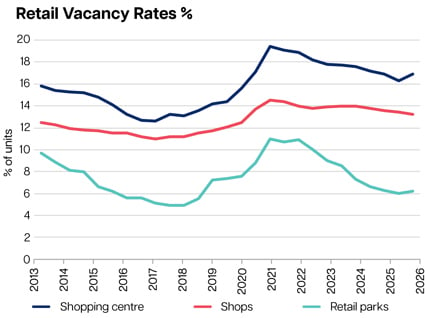
As a result, the vacancy rate for retail warehouses (6.2%, Source: Green Street) remains significantly lower than that of high street shops (13.2%) and shopping centres (16.9%). Retail warehouse rents rose by 3% during 2025 and we expect that trend to continue, assuming consumer spending remains resilient and given the limited pipeline of new development. There are currently only two retail parks under construction, which together will add less than 1% to the national stock of out-of-town space.


 Source: Green Street. 2026.